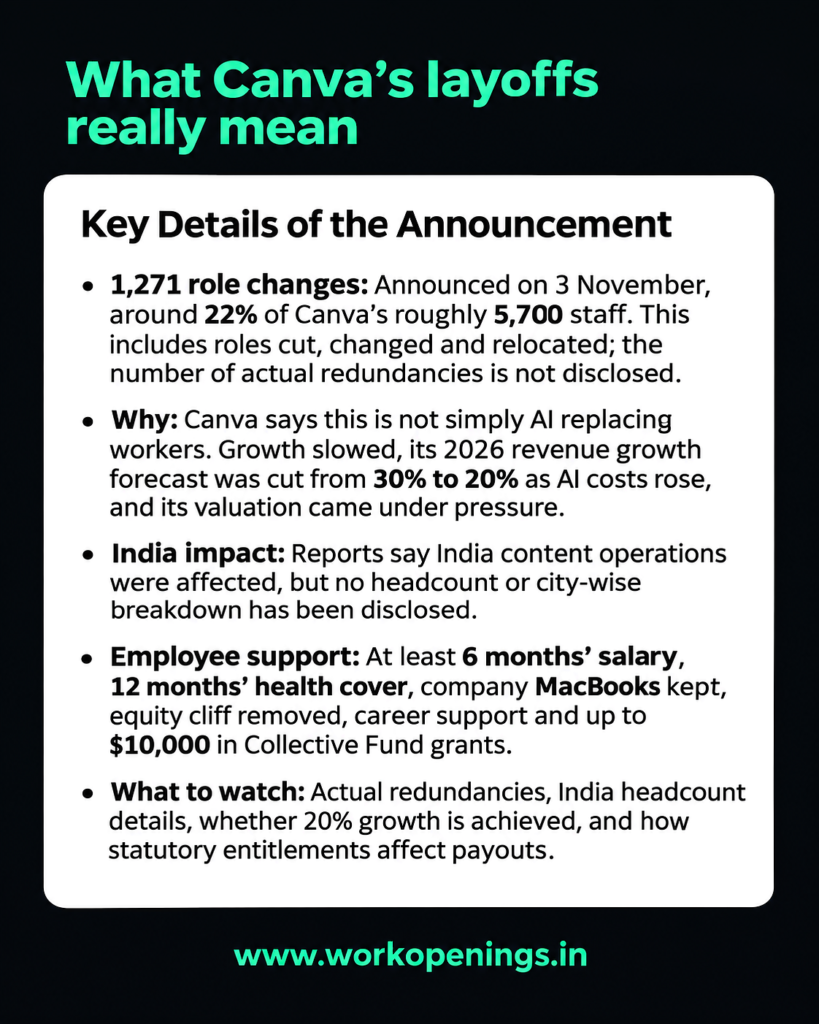
Canva cut 1,271 roles this week. That is about 22% of a company of roughly 5,700 people spread across 37 countries, and it happened fast enough that most of the coverage is still catching up with what the number actually means.
I want to be careful with that figure, because almost every headline is using it loosely. The 1,271 is not 1,271 redundancies. It covers roles being cut, roles being changed, and roles being asked to relocate. Canva has not broken down the split, and until it does, anyone telling you exactly how many people lost their jobs is guessing.
What is clear is that this is the first time in a decade that Canva’s growth has slowed, and the first serious contraction in a company that spent thirteen years only getting bigger.
What happened, in order
On 3 November, Canva CEO and co-founder Melanie Perkins sent a note to staff announcing a restructure. The product, growth and platform teams merge into a single product organisation. Layers of management come out. Sydney becomes the main home for product work, and some roles elsewhere are being pulled toward it.
From January, most hybrid staff are expected in an office two or three days a week.
Perkins called it the hardest moment in the company’s thirteen-year history. In her note she said that after looking at the alternatives, small changes would not be enough.
That line is doing a lot of work. It is the difference between trimming costs and admitting the shape of the company is wrong for what comes next.
The actual Canva layoff reason
Here is where I would push back on most of what is circulating.
The popular version is that AI ate the jobs. A design tool company, 1,271 roles gone, ChatGPT and Gemini now making posters on request. The story writes itself.
Canva says that is not what happened, and the detail supports them more than it supports the headline. A company spokesperson told AAP that the changes are about building new products, not using AI to do the work of people who are leaving. Perkins did not mention AI in her note at all.
What the numbers show is more boring and more worrying. The Canva revenue growth forecast for 2026 was cut by the company itself, from 30% down to 20%. The reason given was rising AI costs, which is close to the opposite of the popular story. AI is not replacing Canva’s staff. AI is expensive, and paying for it has squeezed the business hard enough that something had to give.
Investors noticed first. Canva entered 2026 valued at around $40 billion. T. Rowe Price marked its holding down 20%, implying roughly $30.4 billion as of the end of August. Blackbird cut its internal valuation 17%. Franklin Templeton also wrote its stake down.
So the honest version of the Canva layoff reason is this. Growth slowed, the cost of staying competitive on AI went up, investors repriced the Canva company accordingly, and the org chart got cut to fit the new maths. Competition from AI tools is part of the pressure. It is not the mechanism.
I think that distinction matters for anyone reading this to work out what their own job is worth. “AI replaced them” and “AI got expensive and the company had to pay for it somewhere” lead to very different career decisions.
Canva layoffs India: what we know and what we do not
This is the part Indian readers actually want, and I am not going to pad it.
Reporting from Storyboard18 says the restructure has hit Canva’s India content operations. That is the clearest Canva layoff India detail available right now.
What has not been disclosed: how many people in India were affected, which cities, or what proportion of Canva’s India team is going. Business Today reported that the global workforce of more than 5,700 includes staff based in India, but the company has not confirmed any India numbers. Nobody has published a credible figure.
If you see an article claiming a precise India headcount today, check whether they sourced it or inferred it. Most are inferring.
Two things in the announcement should concern Indian employees more than the raw count.
The first is the Sydney consolidation. When a company decides one city is the home of product work and starts relocating roles there, offices in other countries stop being where decisions get made. Content and operations roles tend to be the first affected, and India is heavily weighted toward exactly those functions at a lot of global product companies.
The second is the reduction in what Canva calls subspecialisation. Remaining staff are expected to take on broader responsibilities. That usually means fewer, more senior people doing more, which thins out the mid-level roles that Indian offices are often built on.
The Canva layoff package, and why I am only half impressed
The severance terms have gone further in the news cycle than the layoffs themselves, and I understand why. They are good.
Anyone leaving gets at least six months of salary, including statutory entitlements, and Canva says that applies regardless of where you are based. Health cover continues for twelve months in countries where Canva already provides it. Staff keep their company MacBook. For anyone who joined in the last year, the one-year equity vesting cliff has been removed, so they leave with something instead of nothing.
The support list beyond the money is longer than most companies bother with. Individual career coaching. Interview preparation. A year of LinkedIn Premium. A year of access to Canva Care, the employee assistance programme, extended to family members. Meetings with senior leaders. An opt-in alumni talent directory that recruiters can approach.
There is also the Canva Collective Fund, which offers grants of up to $10,000 to people starting a business or running a local community project, with no equity taken in return. The registration deadline for interest is 14 December.
Set against the Indian market, where one month of notice is common and three months is considered generous, six months plus a year of health cover is in a different category entirely. The Canva layoff benefits are better than most Indian employees will ever be offered.
And I still think the praise has gone a bit far.
Six months is six months. It ends. The design and content job market it ends into is thin, and it is thin partly because of the same pressures that caused these cuts. A laid-off Canva content specialist in India is now competing for a smaller pool of roles against a larger pool of candidates, with a LinkedIn Premium subscription and a MacBook.
A generous exit is a cushion, not a solution. The package deserves credit as a benchmark other companies should be embarrassed not to match. It does not deserve to be reported as though the people affected are fine.
What the Canva layoffs reddit and forum discussion is adding
Employee discussion is running on Reddit, Blind and LinkedIn, and it is worth reading with the usual caution. Anonymous forum posts are not verified, affected employees are posting while upset, and some accounts claiming inside knowledge have none.
Two themes are worth watching as more detail emerges, because they will be confirmed or disproved in the next couple of weeks. One is whether the relocation offers to Sydney come with real visa and cost support or are effectively a polite exit. The other is whether the six-month figure holds uniformly across countries, or whether “including statutory entitlements” means some employees find their local legal minimum is being counted inside the six months rather than added to it.
I would treat both as open questions rather than facts right now.
What Indian tech workers should take from this
A few practical things.
If you work for an Indian arm of a global product company, find out where product decisions are made. Offices that execute are easier to cut than offices that decide.
If you are in content operations, design support or any role that got defined narrowly during the hiring boom, the trend across this restructure is toward broader roles and fewer of them. Breadth is now worth more than depth in a narrow slice.
If you are offered a severance package, read what the salary figure includes. The Canva wording matters here. “Including statutory entitlements” is a phrase worth understanding in your own contract before you sign anything, and worth asking a lawyer about if the sum is large.
And if you are job hunting into this, be realistic about the design tooling sector specifically. Canva is not a failing Canva company. Its revenue is still growing, just at 20% instead of 30%, and plenty of businesses would take that. But a sector where the leader has stopped accelerating is a sector where hiring stays tight for a while.
Canva news: what happens next
The things to watch are the India headcount disclosure, which Canva has not given; how many of the 1,271 were actual redundancies rather than relocations; and whether the 20% growth forecast holds through the next quarter.
We will update this post as those land.
Sources: reporting from TechCrunch, Forbes Australia, Bloomberg, Business Today, People Matters, Storyboard18 and the Canberra Times, 3 to 5 November 2026. Figures are as reported by Canva and by investors holding Canva stock. Canva has not confirmed a final redundancy count.